Cost of IT Downtime for Growing Companies


Introduction: Downtime Is No Longer Just an IT Issue
In early-stage businesses, a brief system outage may be frustrating but survivable.
In growth-stage and enterprise environments, downtime becomes operational risk.
When infrastructure supports revenue, logistics, client delivery, and communication, even short disruptions ripple through the organization.
The true cost is rarely measured accurately.
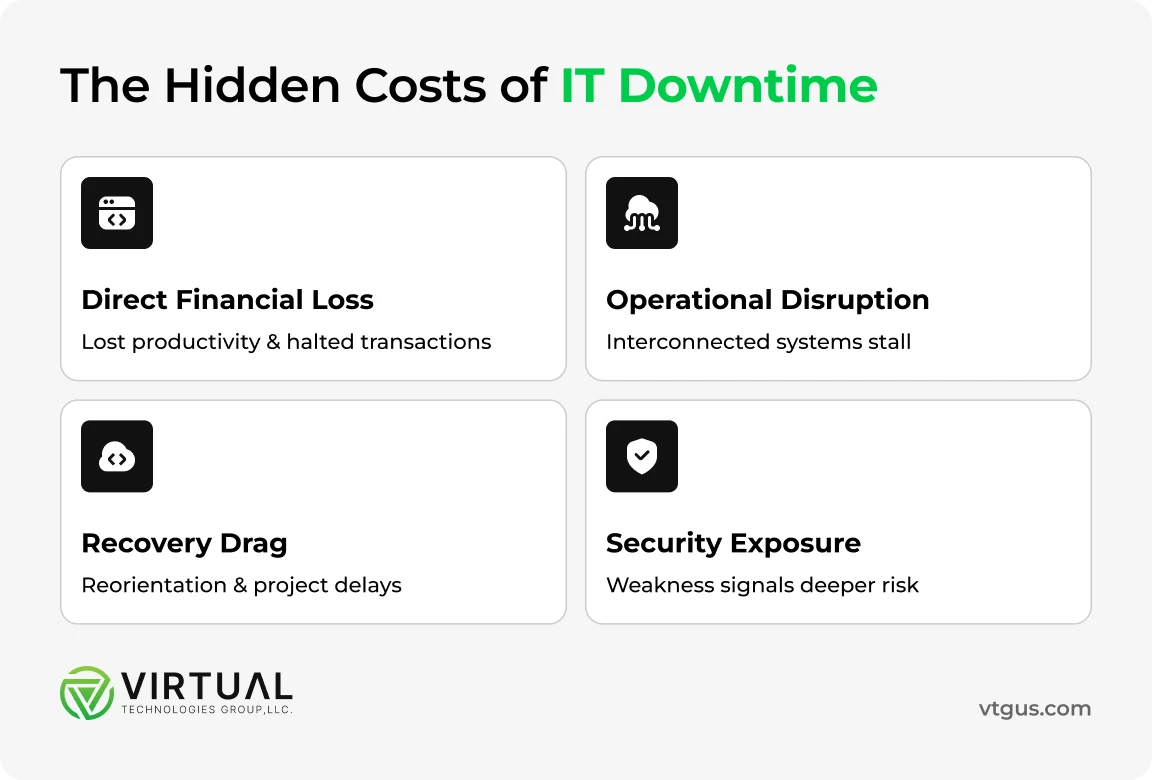
Direct Financial Loss
The most obvious cost of downtime is lost productivity.
When systems go offline:
- employees cannot access tools
- transactions pause
- communication halts
- customer requests stall
If revenue depends on system availability, every minute carries measurable financial weight.
For growing companies, this impact compounds because teams are already operating at capacity.
Operational Disruption
Downtime rarely affects only one system.
Modern businesses rely on interconnected platforms:
- cloud applications
- CRM systems
- ERP tools
- collaboration software
- network infrastructure
When one component fails, workflows stall across departments.
The disruption spreads beyond IT and into operations, finance, and client service.
Hidden Cost: Recovery Time
The most underestimated expense is not the outage itself — it is the recovery.
After systems return:
- teams reorient
- projects restart
- priorities shift
- client trust must be rebuilt
Operational momentum slows long after the outage ends.
Security and Compliance Exposure
Downtime can also indicate deeper vulnerabilities.
Unexpected outages may signal:
- infrastructure weaknesses
- outdated systems
- insufficient monitoring
- limited redundancy
In enterprise environments, reliability and security are interconnected. Instability often exposes broader risk.
Growth Impact
As organizations scale, downtime risk increases unless infrastructure scales with it.
Indicators of risk include:
- reactive support models
- aging network equipment
- limited system documentation
- absence of proactive monitoring
Growth magnifies weaknesses. What was manageable at 20 users becomes disruptive at 200.
Why Adding More Internal Staff Doesn’t Always Solve It
Many companies attempt to solve downtime by expanding internal IT teams.
However, enterprise stability requires structured architecture, monitoring systems, redundancy planning, and lifecycle management — not just additional troubleshooting capacity.
Stability becomes a systems problem, not a staffing problem.
Enterprise IT Approach to Downtime Prevention
Enterprise-level IT strategy focuses on:
- proactive monitoring
- infrastructure standardization
- redundancy planning
- vendor coordination
- lifecycle upgrades
- risk forecasting
Instead of responding to outages, the objective becomes preventing them.
Reliability shifts from reactive support to structured infrastructure management.
Conclusion
Downtime costs extend beyond lost hours. They affect revenue, client trust, operational efficiency, and long-term scalability.
As organizations grow, infrastructure reliability becomes a business strategy decision — not just a technical one.
Recognizing this shift early allows companies to protect growth rather than react to disruption.
Subscribe to our newsletter
Bring your skills, your passion, and your goals - we’ll provide the platform to thrive.

Stay Ahead with VTG Insights