Building an Internal IT Team vs Hiring a Managed IT Provider


How Organizations Decide What Scales Best
As organizations grow, evolve, or modernize their infrastructure, one decision consistently comes into focus:
Should we continue expanding our internal IT team — or partner with a managed IT provider?
There is no universal “right” answer. Both models can work exceptionally well when aligned with the organization’s size, mission, and operational complexity. The key difference lies in how each model scales, adapts, and supports the full technology environment over time.
At Virtual Technologies Group (VTG), organizations often engage after carefully evaluating both paths — not because one is broken, but because their needs have changed.
Growing an Internal IT Team: Strengths and Tradeoffs
Where Internal Teams Excel
Internal IT teams offer advantages that are difficult to replicate externally:
- Deep institutional knowledge
- Strong alignment with company culture
- Immediate proximity to users and leadership
- Long-term continuity within stable environments
For organizations with predictable operations and limited infrastructure variability, internal teams can be highly effective.
Where Internal Teams Face Pressure as Organizations Scale
As environments expand, internal teams often encounter structural challenges:
- Hiring and retaining specialized talent
- Coverage gaps across skills, shifts, or locations
- Knowledge silos tied to individuals
- Increased management and training overhead
- Difficulty scaling quickly for projects or events
Growth introduces complexity that isn’t always solved by adding headcount.
Hiring a Managed IT Provider: Strengths and Tradeoffs
What Managed IT Providers Do Well
Managed IT providers are designed to operate at scale. Their strengths include:
- Access to multi-disciplinary expertise
- Standardized processes and documentation
- Predictable service delivery models
- Rapid scalability for projects, deployments, or events
- Built-in redundancy across personnel and skill sets
For organizations with distributed assets, secure environments, or variable demand, managed IT can reduce operational friction.
Considerations When Partnering Externally
Managed IT isn’t about outsourcing ownership — it’s about sharing responsibility. Successful partnerships depend on:
- Clear service definitions
- Strong communication and governance
- Alignment with internal leadership and teams
- Mutual accountability
The most effective models are collaborative, not replacement-based.
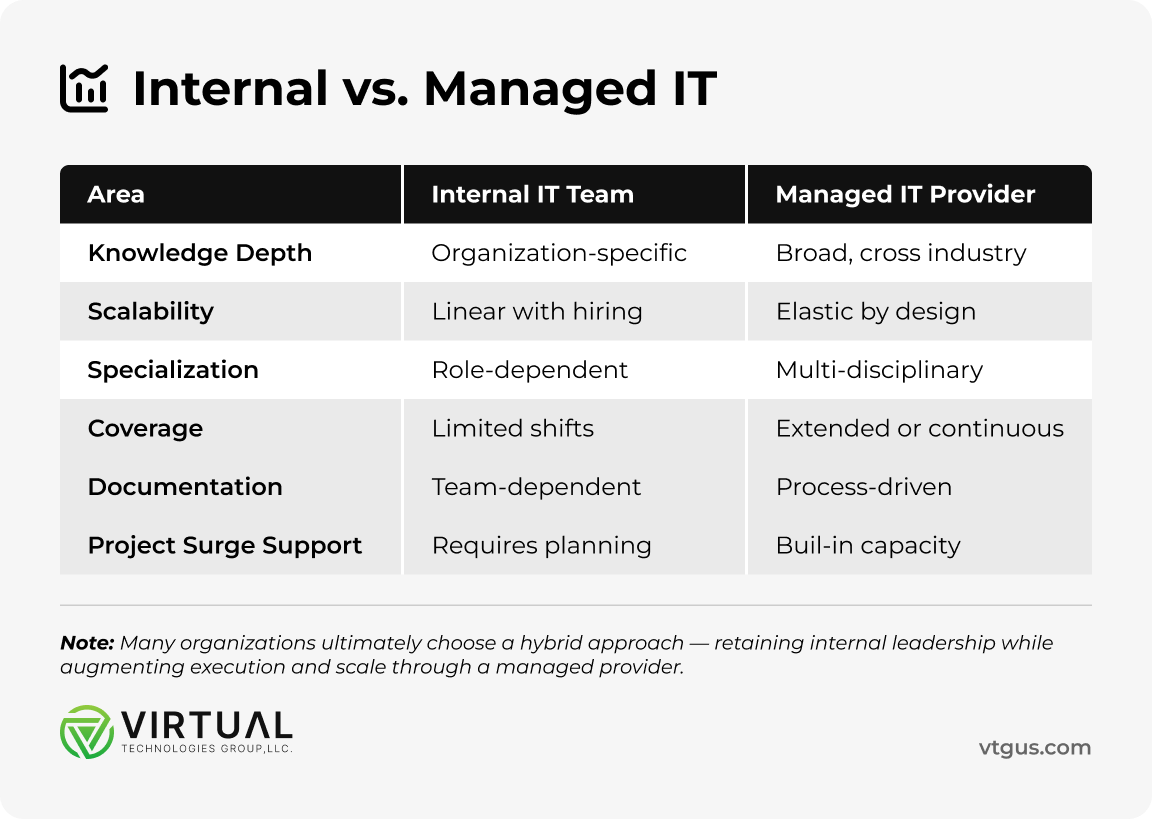
Where the Decision Often Becomes Clear
The choice between internal and managed IT becomes more defined when organizations:
- Support multiple locations or secure facilities
- Manage large or mobile asset inventories
- Host events, installations, or temporary environments
- Require rapid deployment or teardown capabilities
- Operate in government, cultural, or enterprise settings
These environments demand consistency, accountability, and readiness beyond traditional office IT.
How Hybrid Models Are Evolving
Increasingly, organizations are not choosing one or the other. Instead, they are:
- Retaining internal IT leadership and strategy
- Using managed providers for execution, scale, and specialization
- Integrating asset intelligence and lifecycle management
- Standardizing environments across permanent and temporary spaces
This model allows internal teams to focus on direction and governance, while managed partners handle delivery and operational depth.
VTG frequently supports organizations in this exact capacity — extending internal teams without displacing them.
Planning for Growth Without Overcommitting
Whether entering a new fiscal year, launching new initiatives, or preparing for infrastructure expansion, IT decisions today are about flexibility.
Organizations that succeed plan for:
- Predictable day-to-day operations
- Unexpected demands
- Specialized projects
- Long-term infrastructure stewardship
The right model is the one that supports all four without unnecessary strain.
Final Thought
The question isn’t whether internal IT teams or managed providers are better.
The real question is:
Which model — or combination — best supports your organization’s mission today and tomorrow?
For many organizations, the answer evolves over time. And the most effective IT strategies are built to evolve with it.
Subscribe to our newsletter
Bring your skills, your passion, and your goals - we’ll provide the platform to thrive.

Stay Ahead with VTG Insights