Why Growing Companies Eventually Outgrow Their Internal IT


Growth Changes the Role of IT
In the early stages of a company’s development, internal IT teams often focus on supporting day-to-day operations. Tasks like managing employee devices, maintaining internal systems, and resolving support tickets are typically manageable with a small team.
As organizations scale, however, technology infrastructure becomes significantly more complex.
Growth introduces new requirements for security, compliance, system integration, and uptime reliability. What once functioned as a support role increasingly becomes a critical operational function that affects every department across the organization.
For many growing companies, this is the moment when internal IT structures begin to show their limitations.
Infrastructure Complexity Increases Quickly
Scaling organizations rely on increasingly sophisticated technology environments.
New systems are added to support:
• cloud infrastructure
• data management
• cybersecurity monitoring
• collaboration tools
• enterprise applications
Each new layer adds operational complexity that must be monitored, secured, and maintained continuously.
A small internal IT team that once managed a relatively simple environment can quickly find itself responsible for dozens of interconnected systems that require specialized expertise.
Security Expectations Continue to Rise
Cybersecurity is no longer solely an IT concern. It has become a business and operational priority.
As companies grow, they often face higher expectations related to security frameworks, regulatory compliance, and risk management. Organizations must account for factors such as data protection requirements, vendor security standards, and incident response readiness.
Internal teams that were originally structured for technical support may not always have the capacity or specialized training required to manage enterprise-level security operations.
Downtime Becomes More Expensive
For small organizations, temporary system disruptions can often be managed without significant impact.
As companies scale, the financial consequences of downtime increase dramatically.
Sales teams rely on CRM platforms. Operations depend on cloud infrastructure. Customer service teams require constant system access. When core technology systems become unavailable, even briefly, the ripple effects can affect revenue, productivity, and customer relationships.
This raises the importance of proactive infrastructure management and monitoring.
Specialized Expertise Becomes Necessary
Modern enterprise IT environments require expertise across multiple disciplines.
These often include:
• cloud architecture
• network security
• compliance frameworks
• identity and access management
• data protection strategies
Maintaining specialists in each of these areas internally can become difficult and expensive for growing organizations. Even well-staffed IT departments may struggle to maintain expertise across every necessary domain.
The Shift Toward Strategic IT
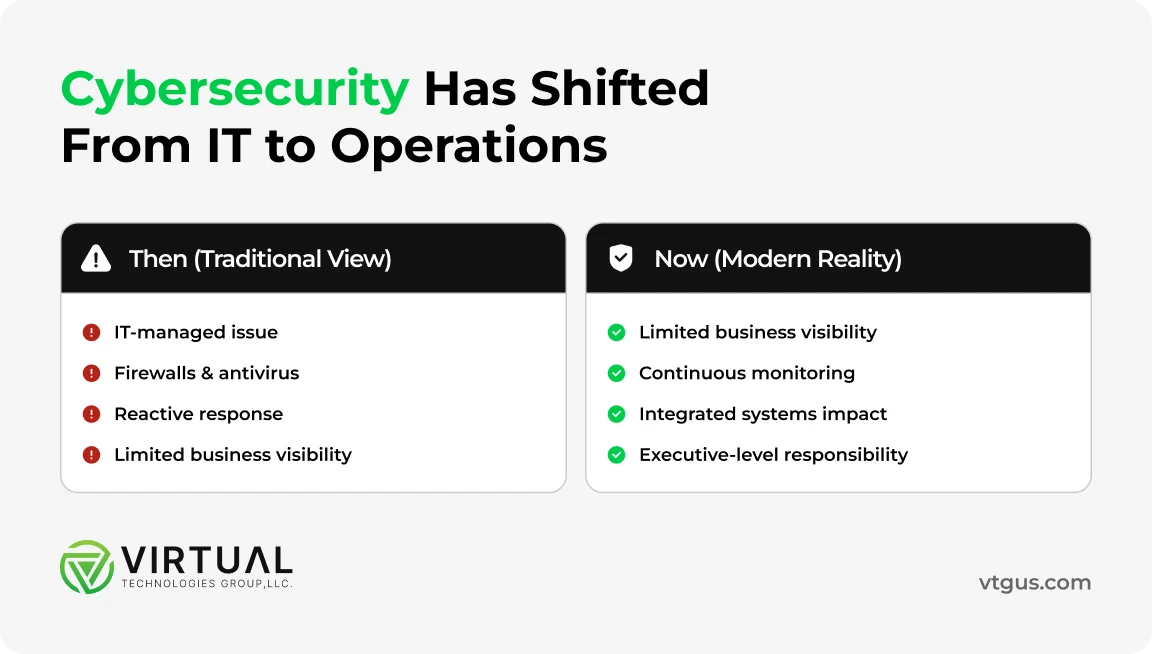
As companies mature, many begin to reconsider how IT functions within the organization.
Rather than operating solely as a support function, technology increasingly becomes a strategic component of growth. Leadership teams often begin evaluating how infrastructure decisions impact scalability, security posture, and long-term operational resilience.
This shift frequently leads organizations to explore new models for managing IT resources and infrastructure strategy.
Preparing for the Next Stage of Growth
Recognizing when internal systems and structures need to evolve is an important step in supporting long-term business growth.
Organizations that proactively evaluate their technology strategy are better positioned to maintain security, reliability, and operational efficiency as they scale.
Enterprise IT environments require careful planning, specialized expertise, and proactive management to support continued expansion.
Conclusion
As organizations grow, the demands placed on their technology infrastructure expand rapidly. Internal IT teams that once effectively supported the business may eventually face challenges managing increasingly complex environments.
Understanding when these challenges begin to emerge allows leadership teams to make informed decisions about how IT should support the next stage of growth.
Learn how organizations are modernizing enterprise IT infrastructure and strategy.
Subscribe to our newsletter
Bring your skills, your passion, and your goals - we’ll provide the platform to thrive.

Stay Ahead with VTG Insights