IT Outsourcing vs Internal IT

Introduction: Growth Forces the IT Decision
As companies scale, technology becomes mission-critical.
Early on, one or two internal IT professionals may support operations effectively. But as infrastructure expands, leadership faces a strategic question:
Should we continue hiring internally, or move to an outsourced model?
The answer depends on scalability, risk tolerance, and operational structure.
The Internal IT Hiring Model
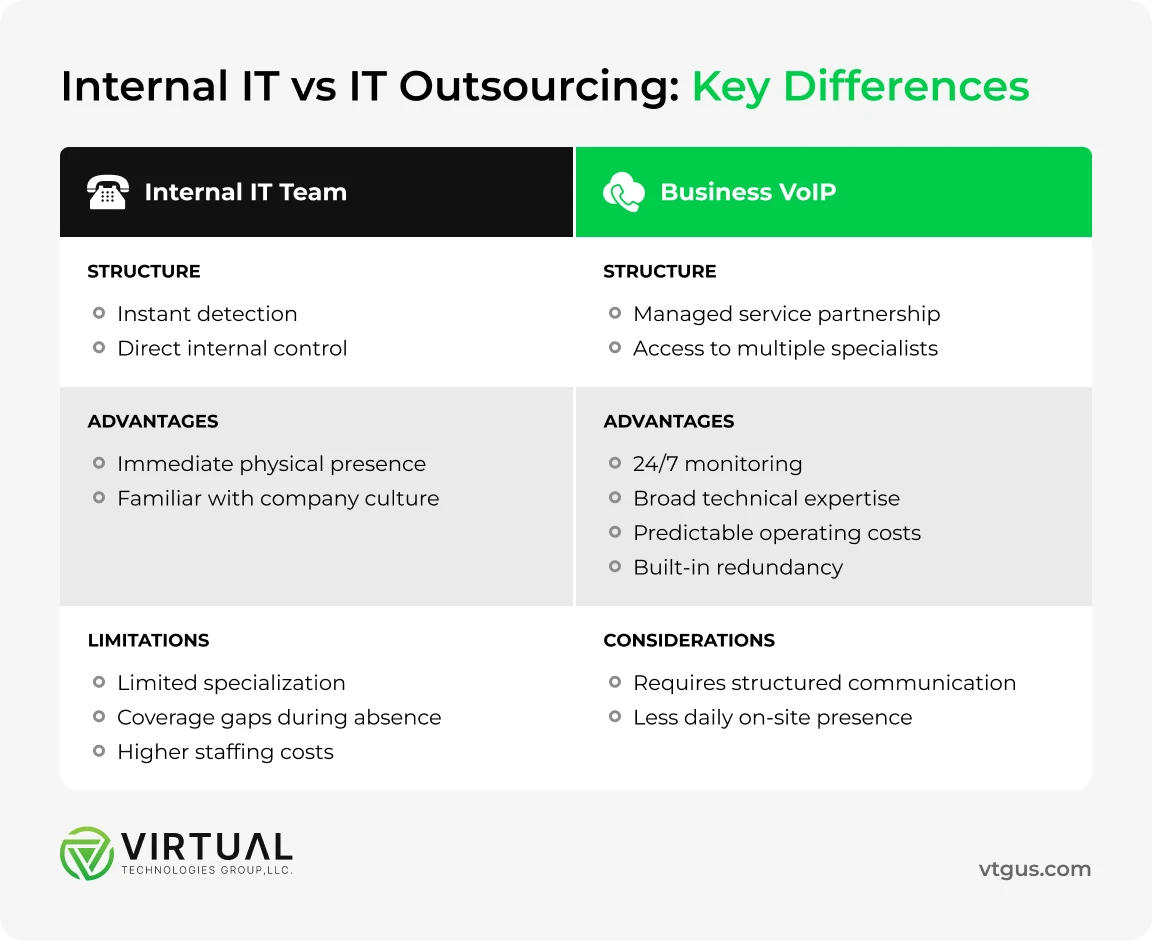
What It Looks Like
- Full-time IT staff
- On-site troubleshooting
- Direct control over daily operations
- Institutional knowledge retained in-house
Advantages
- Immediate physical presence
- Strong familiarity with company culture
- Direct communication channels
Limitations
- Limited specialization per hire
- Salary, benefits, and training costs
- Coverage gaps during absence
- Scaling requires additional hires
As complexity increases, one generalist often cannot cover security, networking, cloud, compliance, and vendor management simultaneously.
The IT Outsourcing Model
What It Looks Like
- Managed service provider partnership
- Structured monitoring systems
- Access to multiple specialists
- Defined service-level agreements
Advantages
- Broader expertise pool
- Predictable operating cost
- 24/7 monitoring capability
- Built-in redundancy
- Faster scaling capacity
Considerations
- Requires strong communication structure
- Less physical presence (depending on provider)
Outsourcing shifts IT from staffing expansion to infrastructure strategy.
Cost Comparison
Hiring internally includes:
- Salary
- Benefits
- Training
- Certifications
- Software tools
- Coverage backup
Outsourcing typically consolidates:
- Monitoring tools
- Security oversight
- Vendor coordination
- Compliance support
- Ongoing lifecycle planning
While cost structures differ, outsourced models often provide more coverage per dollar spent when environments become complex.
Scalability Differences
Internal IT scales linearly, more users often require more hires.
Outsourced IT scales through systems and structured monitoring.
For growing companies, scalability often determines which model prevents operational bottlenecks.
Risk & Security Considerations
As organizations mature, cybersecurity and compliance expand beyond general IT support.
Internal teams may struggle to maintain:
- continuous threat monitoring
- advanced security configurations
- compliance documentation
- infrastructure redundancy planning
Outsourced enterprise IT providers typically embed these systems into ongoing management.
When Internal Hiring Makes Sense
- Smaller organizations
- Stable infrastructure
- Limited regulatory complexity
- Minimal remote workforce
When Outsourcing Becomes Strategic
- Multi-location environments
- Hybrid workforce
- Compliance requirements
- Revenue dependent on uptime
- Rapid scaling
At this stage, IT becomes operational infrastructure rather than internal support.
Preparing for the Right Decision
Before deciding, organizations should evaluate:
- current system complexity
- growth trajectory
- downtime tolerance
- security requirements
- vendor coordination burden
The correct model aligns with future growth, not current comfort.
Upcoming Webinar: Bring Your IT Structure for Review
VTG is hosting a practical session comparing internal and outsourced IT models for enterprise environments.
Participants can bring their current structure, staffing model, or infrastructure questions to evaluate scalability, cost efficiency, and risk posture.
The session focuses on operational alignment, not sales.
Conclusion
IT outsourcing vs internal hiring is not a binary choice. It is a strategic infrastructure decision based on complexity, growth, and risk.
As organizations scale, structured enterprise IT models often outperform reactive staffing expansion.
Subscribe to our newsletter
Bring your skills, your passion, and your goals - we’ll provide the platform to thrive.

Stay Ahead with VTG Insights